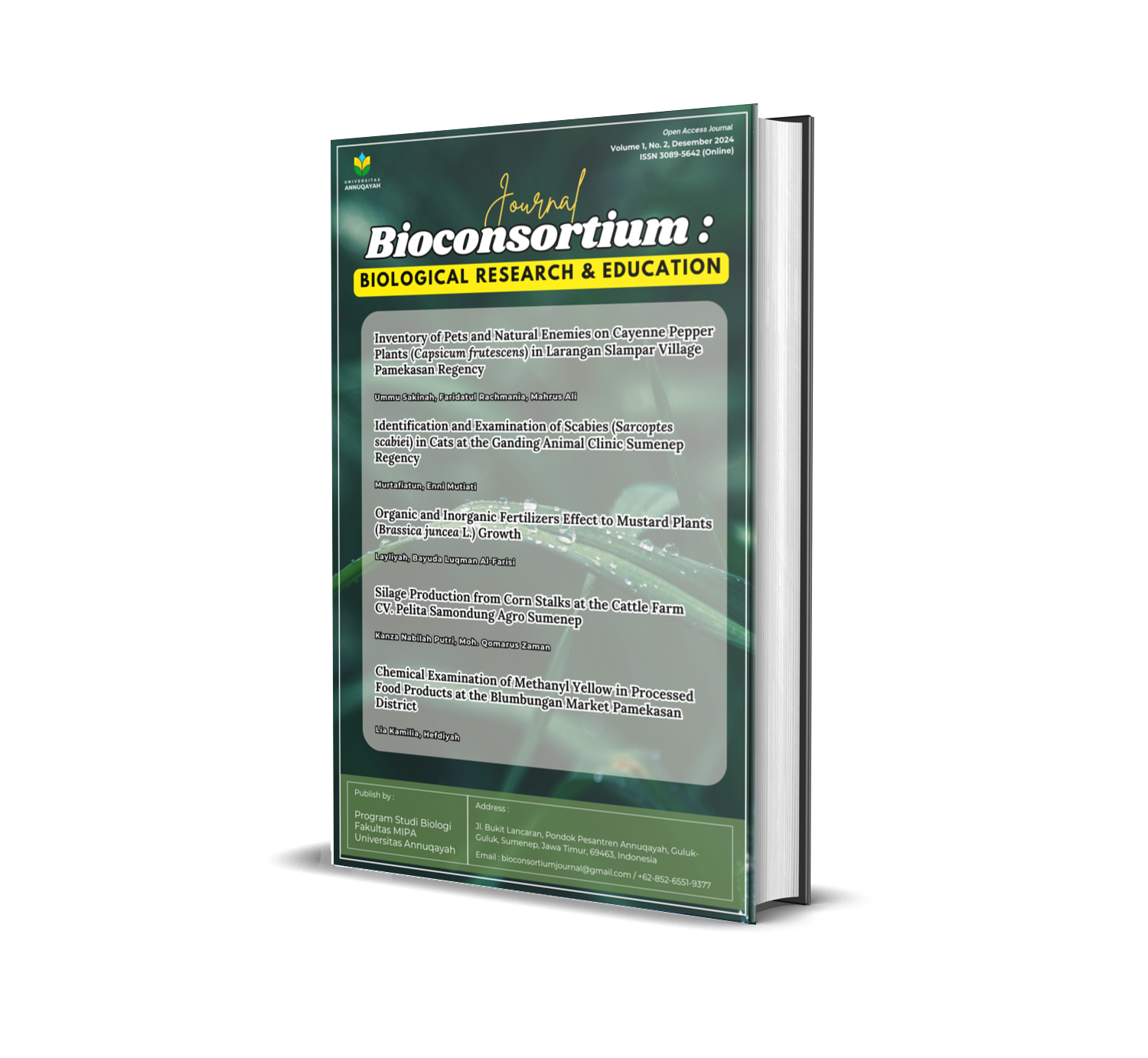
Identification and Examination of Scabies (Sarcoptes scabiei) in Cats at the Ganding Animal Clinic Sumenep Regency
DOI:
https://doi.org/10.59005/bioconsortium.v1i2.535Keywords:
Scabies, Cats, Sarcoptes scabiei, Animal Clinic, Ganding, SumenepAbstract
Scabies in cats is an infectious skin disease caused by infestation with the mite Sarcoptes scabiei or Notoedres cati. Scabies is very contagious, both between cats and from cats to humans (zoonosis). This research aims is to find out what symptoms can cause scabies in cats and how the prevention stages and healing are for cats exposed to scabies at the Ganding Animal Clinic. This research uses quantitative descriptive methods. The results of observations at the Ganding Animal Clinic were that cats exposed to scabies would first be diagnosed through clinical examination and microscopic confirmation of skin scrapings. Then, treatment involves the use of antiparasitics such as ivermectin or selamatectin, accompanied by supporting treatments to reduce symptoms and prevent secondary infections. Prevention can be done by maintaining a clean environment, controlling the stray cat population, and regular inspections. Common symptoms experienced by cats exposed to scabies at the Ganding Animal Clinic are fever with body temperature increasing to 40°C and a rash on the ears and cats often scratching itchy parts of the body. With proper treatment, the prognosis for scabies in cats is generally good, but special attention is needed in severe cases or complications involving secondary infections.
References
Engler, RE. (2017). Performing the Small Animal Physical Examination. 1st ed. Wiley Blackwell.
Fatma, AP., Prihastuti, AE., Yessica, R., Wisesa, IBGR., & Fadli, M. (2021). Penanganan scabies pada kucing mix-persia di Rafa Pet’s Care. ARSHI Veterinary Letters, 8(3): 45-46. DOI: https://dx.doi.org/10.29244/avl.5.3.45-46.
Hay, RJ., Steer, AC., Engelman, D., & Walton, S. (2012). Scabies in the developing world--its prevalence, complications, and management. Clinical microbiology and infection : the official publication of the European Society of Clinical Microbiology and Infectious Diseases, 18(4),313–323. https://doi.org/10.1111/j.1469-0691.2012.03798.x
Hnilica, KA., & Patterson, AP. (2017). Parasitic Skin Disorders. In Small Animal Dermatology. 4th ed. Elsevier. P132-172.
Huang, HP., Liang, SL., Yang, HL., & Chen, KY. (1998). Sarcoptes scabiei Infestation in a Cat. http://www.innovet.com/journalis/felprac/abstr98/260202.htm Diakses [16 Maret 2024].
Leppard, B., & Naburi, A. E. (2000). The use of ivermectin in controlling an outbreak of scabies in a prison. The British journal of dermatology, 143(3), 520–523. https://doi.org/10.1111/j.1365-2133.2000.03704.x
Morelli, S. Diakou, A., Di Cesare, A., Colombo, M., & Traversa, D. (2021). Canine and Feline Parasitology: Analogies Differences, and Relevance for Human Health. Clinical Microbiology Reviews. 34(4):1-55.
Pudjiatmoko, MS., Nurtanto, S., Lubis, N., Syafrison, SY., Kartika, D., Yohana, CK., Setianingsih, E., Efendi, ND., & Saudah, E. (2014). Manual Penyakit Hewan Mamalia. Subdit Pengamatan Penyakit Hewan Direktorat Kesehatan Hewan Direktorat Jenderal Peternakan dan Kesehatan Hewan Kementerian Pertanian. 2nd printing. 2014:438-446.
Soeharsono. (2007). Penyakit Zoonotik pada Anjing dan Kucing. Yogyakarta: Kanisius.
Soulsby, EJL. (1982). Helminths, Arthropods & Protozoa of Domesticated Animals. 7th Ed. London: Bailliere, Tindal and Casseli.
Sugiyono. (2017). Metode Penelitian Kuantitatif, Kualitatif dan R&D. Bandung: CV. Alfabeta.
Taylor, MA., Coop, RL., & Wall, RL. (2015). Veterinary Parasitology. 4th ed. Wiley-Blackwell.